
The Role of Social Media in Setting Public Narratives
tyccAd | August 5, 2026 | Public Relations,Branding,Digital PR,Social Media,media relations






Think about the last major news story you heard about. Did you see it on television or read it in a newspaper? Or did it appear while you were scrolling through Instagram, X, YouTube, or Facebook?
For millions of people, social media is now the first place where a story begins. But here is the bigger question: Who decides which story you see?
Often, the answer is the platform’s algorithm.
Social media is no longer just a space to share photos and opinions. It has become a powerful force in shaping public narratives, influencing what people discuss, believe, and remember. For brands, this makes a strong communication strategy more important than ever. At TYC Communication, understanding this shift is key to helping brands stay relevant in a fast-changing digital world.
A public narrative is the perception that develops around an issue, person, organisation, or event.
The same event can create very different opinions depending on which facts are highlighted, which voices are heard, and how often the story appears online.
Earlier, newspapers and television channels had significant influence over public conversations. Today, anyone with a smartphone can record an event, share an opinion, or challenge an established narrative.
One video can spark a debate.
One hashtag can turn a local issue into a national conversation.
One post can make millions of people ask, “What is really happening here?”
For businesses, reputation is no longer shaped only through traditional media. Social posts, customer comments, reviews, and online conversations all contribute to the public story around a brand. This is where a Best Brand Management Agency must look beyond visual identity and understand how a brand is perceived online.
When you open Instagram or X, you don’t see every post from every account you follow. The platform decides what appears on your feed.
This is where algorithms come in.
They study what you watch, click, like, share, and comment on. Based on your activity, they recommend more content they believe will interest you.
If you regularly engage with political content, you may see more political discussions. If you watch education-related videos, you may receive more of the same.
The more you engage with a particular narrative, the more similar content you may see.
Slowly, it can feel as if everyone is talking about the same issue.
Algorithms do not necessarily create narratives, but they help decide what gets seen, repeated, and discussed.
And attention can shape perception.
This is why a Best Branding Agency today must understand not only how a brand looks but also how its message travels and how audiences respond.
Why does one post get millions of views while another barely gets noticed?
Content that creates strong emotions often gets more engagement. Anger, surprise, fear, hope, humour, and controversy can make people stop scrolling and interact.
The cycle is simple:
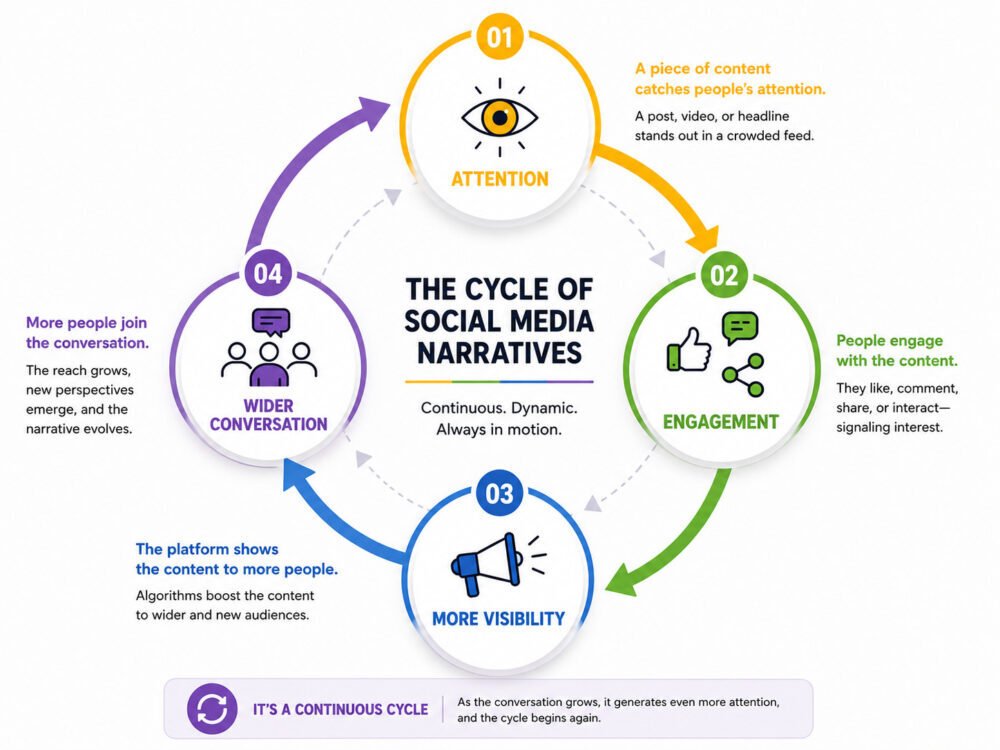
Attention → Engagement → More Visibility → Wider Conversation
This can help important issues reach a larger audience. But it can also allow incomplete information or one-sided narratives to spread quickly.
For communication professionals, the challenge is to earn attention without compromising accuracy or credibility. This is where a Best PR Company in Delhi must go beyond traditional media relations and understand how digital conversations influence public perception.
A recent protest involving Gen Z supporters and the CJP over demands linked to Union Education Minister Dharmendra Pradhan offers an example of how an issue can move from the streets to social media and into a wider public debate.
The protests, connected to concerns around the NEET examination and demands for accountability, attracted attention from students, political voices, universities, and the wider public. Online discussions and reactions helped amplify the conversation.
Think about how quickly such a story can spread:
A protest takes place.
Someone records it.
The video is uploaded.
People share and discuss it.
Influencers and public figures join the conversation.
News organisations pick up the story.
Suddenly, an issue that began with a group of people is being discussed by millions.
But this raises an important question:
Are we seeing the complete story, or only the part the algorithm thinks we will engage with?
This is the power of digital platforms. They can give visibility to voices that may otherwise go unheard. But they can also create a narrow view when people repeatedly see similar opinions.
When something starts trending, it immediately appears important. But trending does not mean everyone agrees with it. It simply means there is a high level of activity around the topic.
Still, repeated exposure can influence perception.
When people see a hashtag everywhere, they may assume it represents the majority opinion. When they repeatedly see one side of a debate, they may begin to believe it is the only side.
The more visible a narrative becomes, the more important it can appear.
For brands and organisations, this has changed communication forever. You are no longer speaking to an audience that simply listens. You are entering a conversation.
At TYC Communication, this means looking beyond individual posts and campaigns to understand the larger conversation around a brand and help it communicate with purpose and credibility.
A strong PR strategy today cannot exist separately from social media.
A press release tells the story. A news article adds credibility. An interview provides context. Social media takes the conversation directly to the public.
For communication professionals, the job is not simply to “post more.” It is to understand:
The goal is not to control the conversation.
It is to participate in it responsibly.
A modern Digital PR Agency in Delhi must combine traditional PR thinking with an understanding of social media behaviour. It must understand how coverage travels online, how audiences respond, and how narratives evolve.
Yes, but they cannot control everything people say about them.
When a brand faces criticism online, it can remain silent and allow others to define the story. Or it can listen, respond with facts, and communicate openly.
The second approach may not convince everyone, but it gives the brand a chance to be heard.
This is why businesses increasingly work with a Digital PR company in Delhi that understands the connection between earned media, social platforms, influencers, online communities, and public perception.
Social media has changed one fundamental thing about communication:
The audience is no longer just listening. The audience is participating.
A public narrative can be challenged, reshaped, questioned, and amplified within minutes.
The question is no longer just:
“What do we want to say?”
It is:
“What will people say after we say it?”
And perhaps even more importantly:
“What will the algorithm show them next?”
At TYC Communication, the opportunity is to help brands become part of meaningful conversations rather than simply adding to the noise. In a world where narratives can change in real time, communication must be thoughtful, timely, and ready to evolve.
Because today, the most powerful narrative is not necessarily the one told the loudest.
It is the one that people believe, engage with, and choose to carry forward.
Uppal Plaza, M6, Suit - 3B, 3rd Floor, District Centre,
Jasola, New Delhi – 110025